What is margin governance?
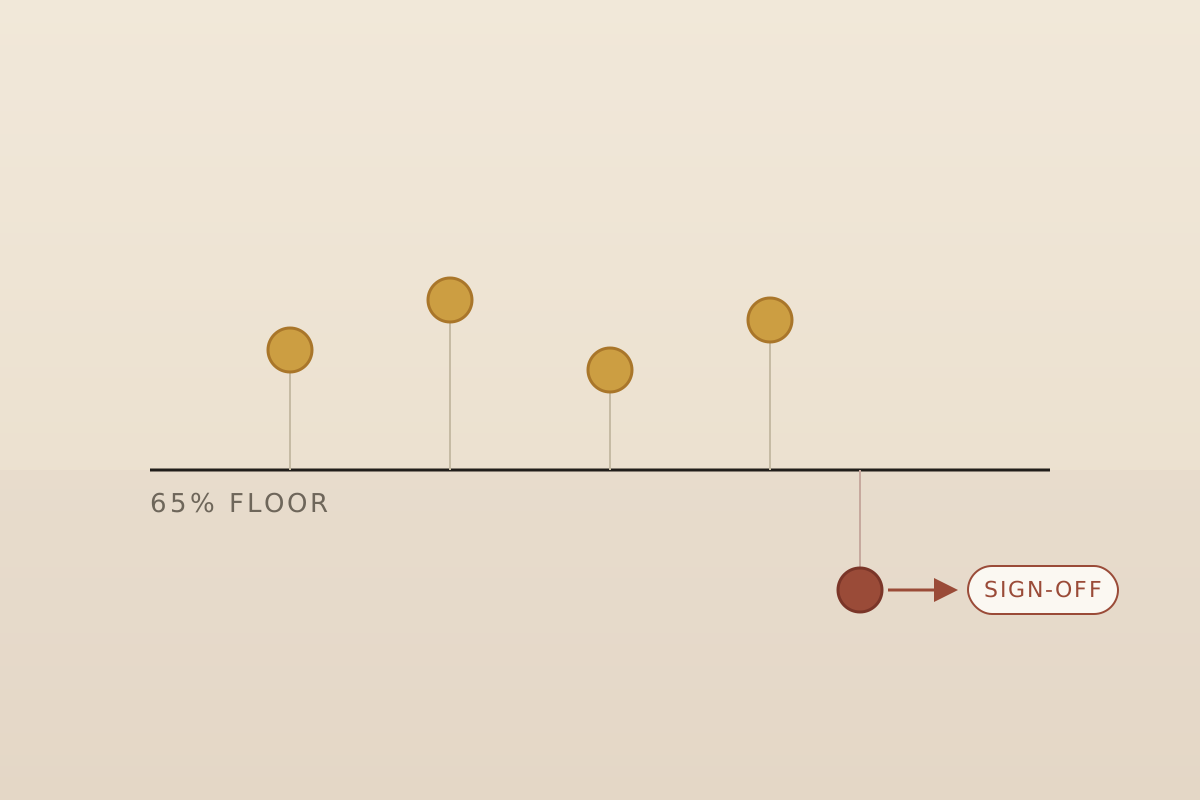
Margin governance is the practice of setting a minimum acceptable margin, a floor, and enforcing it on every quote before that quote reaches a customer. Instead of finding out at quarter-end that deals went out underwater, a team with margin governance checks the true profitability of each deal at quote time, lets the deals that clear the floor go out freely, and routes the ones that fall short to the right person for sign-off.
What margin governance involves
Margin governance has four moving parts. Take any one of them away and governance breaks.
A floor with no real cost data is guessing. Real cost data that nobody checks at quote time is just a report. A check with no routing is a roadblock.
Margin governance is not the same as watching discounts
The most common mistake is treating a discount threshold as margin control. They are not the same thing.
A discount is a proxy for margin, and a loose one. A 20% discount on a low-cost deal can clear a 65% floor comfortably, while the same 20% discount on a deal heavy with implementation, freight, and royalties can land well below it. If your only guardrail is "discounts over 25% need sign-off," the deals that actually lose money, the ones that are expensive to deliver, can pass straight through while cheaper deals get flagged for no reason.
Margin governance checks the margin itself, computed from real cost, against the floor. The discount is just one input.
Who needs margin governance
Margin governance earns its place when one or more of these is true:
- Your cost to deliver is more than unit cost, with freight, labor, services, or royalties stacked on top.
- Reps discount with discretion, and those discounts quietly erode margin.
- You sell multi-year or service-heavy deals where margin plays out over the whole term.
- You have found deals that went out below floor after the fact.
- Finance only sees true margin at quarter-end, not at the moment a quote goes out.
If a few of those land, the gap between the number on the quote and the real margin is already costing you.
A quick example
Two deals, both quoted at 20% off list, against the same 65% floor.
Same discount, opposite outcomes. That difference is the whole point.
Where margin governance sits
Margin governance does not replace your quoting stack. A CPQ still builds the quote, your CRM still tracks the deal, and your finance team still owns the targets. Margin governance is the layer that makes sure nothing goes out below the floor, and it works whether you quote from a CPQ, a CRM, or a spreadsheet, because it runs off your real P&L rather than off how the quote was assembled.
For how this differs from a CPQ specifically, see Is Dealfloor a CPQ? For how it relates to a deal desk, see Deal desk vs CPQ.
The pattern underneath
Where to start
Start with the floor. Decide the minimum margin a deal must hit, by segment if your business needs it, and write it down. Then make sure you can see the real cost to deliver on a deal, not just list minus discount. Once you have those two, the rest of margin governance is enforcing them on every quote and routing the exceptions.