Complex deal calculators
Empowering sales to close and finance to govern.
01 · The complex deal problem
Not every deal needs governing. A list-priced, single-product, one-year sale is easy to check by eye. The deals that cause trouble are the ones whose price is assembled rather than listed.
A complex deal usually carries several of these traits at once: multiple product segments sold together, a mix of one-time and recurring revenue, hardware paired with consumables or services, multi-year terms with price changes built into the later years, channel or group-purchasing fees that come straight off the top, and equipment whose cost is recognized differently depending on how the deal is structured. Price one of these by hand and you are really building a small financial model, deal by deal, under deadline pressure, in a spreadsheet.
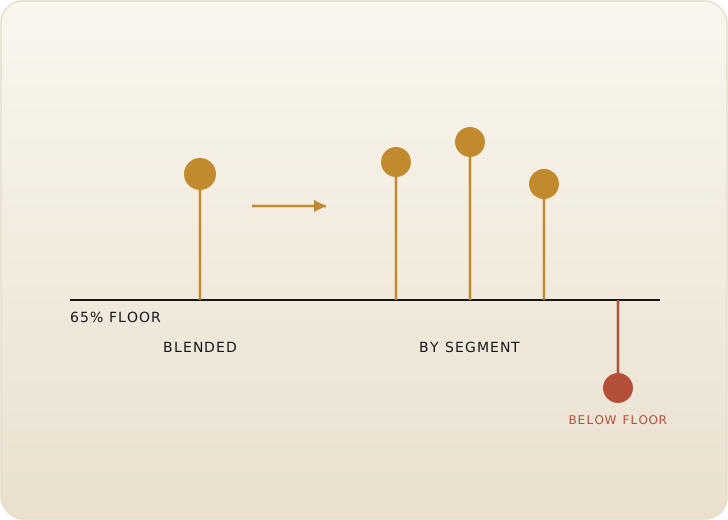
The blended number hides the weak segment. This is the central trap. Picture a five-year agreement with a mid-market buyer, call it Meridian Group, that lands at a comfortable looking blended margin. Inside it, the equipment is being given away to win the consumables, and one product line is quietly underwater. The blended figure clears, so the deal goes out, and the company spends five years losing money on a segment no one looked at closely. Healthy averages routinely conceal unhealthy parts.
The spreadsheet is fragile and unauditable. Pricing workbooks sprout tabs, accumulate broken references, and get copied into "final" and "final v2" versions that slowly drift apart. A single mistyped discount or an out-of-date cost can swing the outcome by tens of thousands of dollars, and nothing flags it. Once the deal closes, there is no reliable record of which numbers were actually used.
Approvals are slow and opaque. When a deal does need a second look, it usually travels by email. A rep forwards a workbook, waits, pings a manager, waits again, and loses momentum with the customer while the deal sits in someone's inbox. No one can see where it is in the process.
There is no memory. Months later, when a deal is questioned, no one can reconstruct what was approved, by whom, or on what basis. The reasoning lived in a hallway conversation and an attachment that has since been overwritten.
The rep is either flying blind or holding too much. Either the rep cannot tell whether a deal is sound until it comes back rejected, or the rep is handed the entire cost stack, which is more financial detail than a sales conversation should carry, and more than most companies want circulating.
None of this is a discipline problem. It is a tooling problem. The work simply outgrew the spreadsheet.
02 · What a complex deal calculator is
A complex deal calculator is a governed engine that models the true per-deal, per-segment profit and loss, and converts it into a decision.
The emphasis belongs on both halves. Plenty of tools can produce a number. What makes this category distinct is that it produces a governed outcome: it knows your margin floors, it knows who is allowed to approve what, and it turns the math into an action that either moves the deal forward or routes it to the right person, while keeping a complete record of how it got there.
It is worth being precise about what it is not. It is not a quoting or CPQ tool, whose job is to assemble line items and output a customer-facing document. It is not an ERP, which records what already happened. It sits between them, at the moment of decision, and answers a single question that neither is built to answer well: given everything in this specific deal, does the margin hold, and if not, who needs to weigh in?
The useful shorthand is that a complex deal calculator is better than a spreadsheet and lighter than a CPQ. It brings rigor and auditability a spreadsheet can never have, without the weight and long implementation of a full configure-price-quote platform.
03 · Anatomy of the engine
A complex deal calculator is made of a handful of parts that work together. Understanding them is the clearest way to see what separates a real governance engine from a calculator with a nicer interface.
The profit and loss engine. At the core is a model that builds the real P&L for the deal, segment by segment, across every year of the term. It works down the full waterfall: direct costs such as bill of materials and royalties, the cost to serve such as field service and support, commercial costs such as channel and group-purchasing fees and distributor margin, and overhead. It separates one-time items in the first year from recurring costs in later years, applies the right equipment cost treatment for the deal type, and carries forward any price changes scheduled for the out years. The output is not a single margin but a structured view of gross and contribution profit for each segment and for the deal as a whole.
The margin floor, measured per segment. The engine holds each segment to a floor: the minimum acceptable margin for that kind of business, which can vary by product line, contract length, and volume. Crucially, it checks segments individually rather than letting a strong blended average paper over a weak part. A deal does not clear simply because the whole is healthy. Each segment has to stand on its own, or the shortfall is surfaced rather than buried.
Approval routing on an authority matrix. When a deal falls short of a floor, or its value crosses a defined threshold, the engine routes it for sign-off automatically. Who it routes to is governed by an authority matrix that maps deal value and risk to the right approvers, so a modest exception and a multi-million-dollar commitment do not land on the same desk. Approvals run in parallel where more than one party is required, and a single denial is enough to stop a deal, so nothing slips through on a partial yes.
Role-based visibility. Different people see different things, by design. The sales team sees the verdict, whether a deal is good to send or needs sign-off, without the underlying cost stack. The full economics stay with operations and finance, where they belong. This is what lets the same system empower the rep and protect the numbers at once: the rep gets a fast, clear answer, and sensitive margin detail does not travel with the quote.
Audit trail and private deliberation. Every input, decision, and message is recorded, and the trail starts the moment a deal is built, not just when it is approved. Approvers can discuss a deal among themselves, out of the rep's view, and that deliberation is logged without being exposed to the sales floor. When a deal is later questioned, the whole history is there.
Governed overrides. Real pricing needs the occasional exception, but exceptions are where ungoverned spreadsheets quietly break. The engine lets authorized people override specific inputs, while enforcing who is permitted to change what, and recording every change. Flexibility stays available without becoming a back door.
Catalog governance. The costs the engine uses are anchored to a single, controlled source rather than retyped into each deal. Cost fields are locked so they cannot be casually edited mid-deal, and they update from one authoritative place. Everyone prices off the same numbers, and those numbers are current.
04 · Who it is for, and where it sits
Who it is for. A complex deal calculator earns its place anywhere price is assembled rather than listed. That includes diagnostics and medical technology, where instruments are placed and revenue comes from years of consumables and service; industrial businesses that sell equipment alongside parts and maintenance; any capital-plus-service model; and businesses that sell through channels and group-purchasing arrangements that take a cut off the top. If your deals combine several products, several years, and several cost types, you are a candidate.
Who it serves inside the company. It serves several roles at once. Sales reps build deals and get a clear answer. The deal desk and operations team configure the rules and keep the engine honest. Finance approvers and regional leaders sign off on exceptions with the full picture in front of them. Administrators manage rates, floors, and the authority matrix. And, increasingly important, the internal systems or IT group is the team that eventually inherits and maintains the tool, which means how cleanly it can be handed over matters from day one.
Where it sits. In the deal flow, the calculator lives at quote and approval time, between the CRM or CPQ where the deal is shaped and the finance sign-off that releases it. It is the checkpoint the deal passes through on its way out the door. And because deal economics are among the most sensitive data a company holds, it is delivered as a dedicated, isolated instance, styled to fit alongside the team's other internal tools rather than as a shared seat in someone else's platform.
05 · Why it matters now
The payoff shows up in five places. Margin is protected segment by segment, so the quiet losers are caught before the deal goes out, rather than discovered a year into the contract. Approvals move in minutes instead of days, because routing is automatic and parallel rather than a manual relay through inboxes. Every deal is auditable, which turns disputes and governance reviews from archaeology into a lookup. Sales is empowered rather than slowed: a rep gets a clear, immediate signal, good to send or submit for sign-off, and can keep the conversation moving with confidence. And there is a single source of truth, one engine and one set of current costs and rules, replacing a drawer full of spreadsheet versions that no longer agree.
06 · From spreadsheet to governed engine
The path from a workbook to a governed engine is not mysterious. Every step is knowable, and most of the logic already exists, trapped in a spreadsheet and in a few people's heads. What separates the teams that get there from the ones that stall is rarely knowing the steps. It is the execution, and the question of who carries the result afterward.
Model the real P&L. Start by reproducing the full per-segment waterfall the business already uses, so the engine's numbers reconcile exactly with the workbook everyone trusts today.
Set the floors. Define the minimum margins by segment, term, and volume, turning informal "we don't go below this" knowledge into explicit, enforced rules.
Codify the authority matrix. Write down who approves what, by value and risk, so routing stops depending on who happens to know whom.
Lock the catalog. Anchor costs to one controlled source and close off casual edits, so everyone prices off the same current numbers.
Wire approvals and audit. Connect the routing, the notifications, and the record, so exceptions move quickly and nothing goes unlogged.
Hand it to the owners. Because the tool will be lived in and maintained internally, plan the handover from the start, with a clean codebase and clear documentation for the team that inherits it.
None of these steps is exotic on its own. The difficulty is that they have to be right together, and stay right. The floors have to match how the business actually decides, the authority matrix has to survive reorganizations, the catalog has to stay current, and the whole thing has to be maintained as a live piece of software rather than a project that ends. That is real, ongoing work, and it is where good intentions usually run out.
So the honest version of build or buy is less about whether you could model your own P&L. You could. It is about who owns and runs the engine once it exists. A sensible way to start is with a single deal type, proven against the spreadsheet everyone already trusts, then expanded from there. Whether you build that yourself or have it built to your model and handed to you, the deciding question is the same: who keeps it alive afterward. That is the part worth settling before anyone writes the first formula.
07 · Challenges and considerations
This is not magic, and it is worth being honest about where the work is.
The floors and thresholds are the hard part. Setting them is a business exercise, not a technical one. The engine will enforce whatever rules you give it, so the rules have to reflect how the business actually decides.
Change management with sales matters. A new checkpoint can feel like friction until reps experience it as the opposite: a fast yes on most deals and a clear path on the rest. Framing it as empowerment, not control, is what earns adoption.
Permissions need discipline. The value of role-based visibility and governed overrides depends on the roles being set up carefully and reviewed, especially as teams change.
The source of truth has to stay current. A calculator anchored to a cost catalog is only as good as that catalog, so keeping it updated is an ongoing responsibility, not a one-time setup.
Ownership and portability deserve clear answers. Because this is sensitive data in a dedicated instance, the questions a serious internal systems team will ask, about ownership, portability, data handling, and what happens if you part ways, deserve transparent answers from the outset. A tool you cannot cleanly take ownership of is a risk, however good the math.
08 · Conclusion
Complex deals are not getting simpler. Bundles are getting larger, terms longer, and pricing more bespoke, which means more margin is flowing through exactly the kind of deal a spreadsheet governs worst. The companies that stay in control will be the ones that treat per-deal margin as something to govern deliberately, with a real engine, rather than something to estimate in a workbook and hope for.
A complex deal calculator is how that control becomes routine. It runs the real P&L on every deal, holds each segment to its floor, routes the exceptions to the right people in minutes, and remembers everything. Sales moves faster. Finance stays in control. And the margin is known before the deal goes out, not after.