Is Dealfloor a CPQ? Where margin governance fits
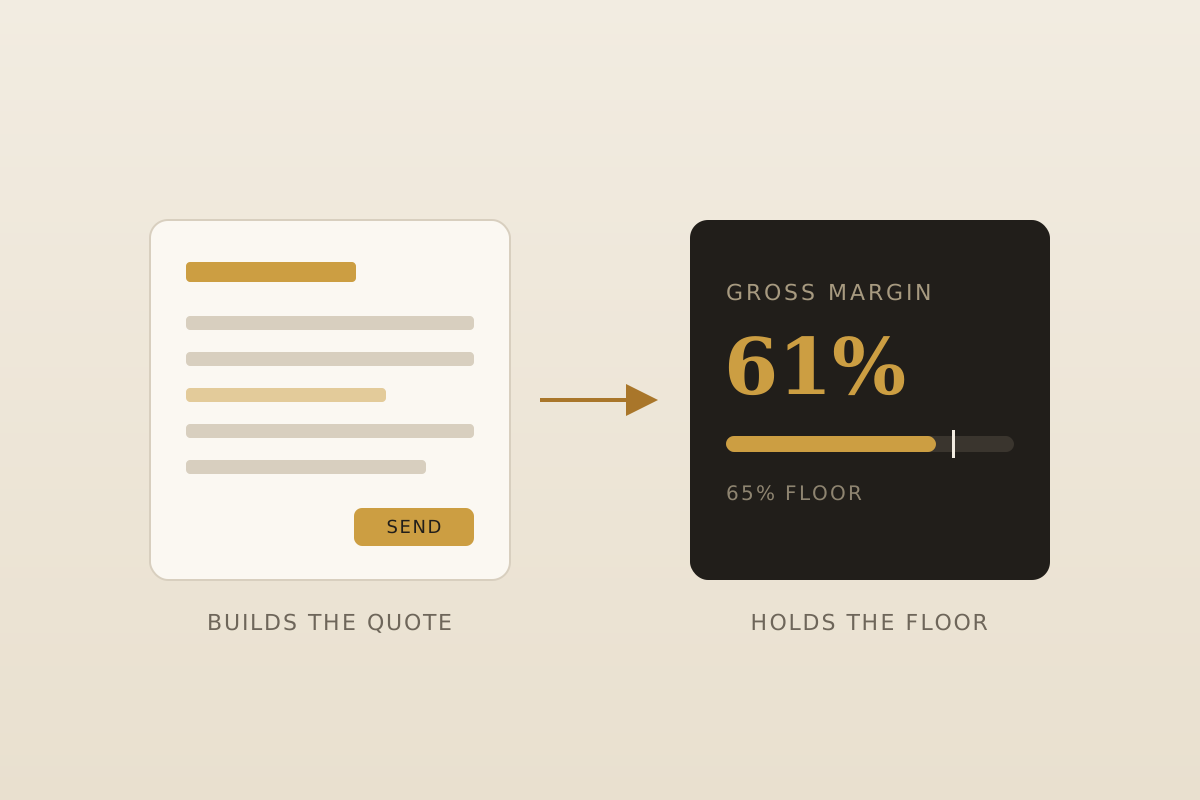
If you only remember one line: a CPQ asks "is this quote built correctly?" Dealfloor asks "is this quote profitable, and if not, who approves it?"
CPQ vs Dealfloor at a glance
| CPQ | Dealfloor | |
|---|---|---|
| What it's for | Building and configuring the quote | Governing the margin behind the quote |
| Core job | Configure products, apply price books, generate the quote document | Calculate true P&L per deal, hold the margin floor, route exceptions |
| What approvals trigger on | Discount % off list, or price thresholds | True gross margin vs your floor, on fully-loaded cost |
| Cost data it uses | List price and discount. Cost usually not modeled | Real cost to deliver: COGS, freight, labor, royalties, multi-year service |
| When it acts | As the rep builds the quote | Before the quote goes out, on every deal |
What a CPQ does
CPQ stands for Configure, Price, Quote. A CPQ helps a rep assemble a correct, sendable quote: it configures the product or bundle (handling valid combinations and dependencies), applies the right price book and discounts, and generates the quote or proposal document, often with e-signature and a sync back to the CRM. Many CPQs also include discount-approval workflows that route a quote for sign-off when the discount crosses a threshold.
CPQs are good at what they're built for: making the quote accurate, consistent, and fast to produce. None of what follows is a knock on that.
What Dealfloor does
Dealfloor governs the margin behind the quote. It takes the real cost to deliver a deal, COGS, freight, labor, royalties, multi-year service, and calculates the true gross margin on every quote. If a deal lands below the floor your finance team set, Dealfloor blocks it from going out and routes it to the deal desk for sign-off, with the full P&L attached.
It's the check that happens before the quote leaves the building, on every deal, based on what the deal actually costs you.
Why "we have a CPQ" usually isn't enough
This is the most common, and fairest, question: if a CPQ already has discount-approval workflows, why add a margin layer?
The answer is what each one checks. A CPQ approval almost always triggers on discount percentage off list price: "25% off needs VP sign-off." That's a proxy for margin, not margin itself. It doesn't know your fully-loaded cost to deliver, so a deal can clear the discount guardrail and still be underwater. A CPQ can sometimes be extended to pull in cost and margin, but that isn't what it's built for, and in practice the cost data is usually missing or stale. Dealfloor checks the actual margin, computed from real cost, against your floor, every time.
A deal that clears CPQ but breaks your floor
Take a quote at 22% off list. The CPQ's rule says discounts over 25% need sign-off, so at 22%, it sails straight through, no approval required.
But load in what it actually costs to deliver: implementation labor, third-party freight, a royalty on one line. The real gross margin lands at 61%, under the company's 65% floor.
Same quote, two completely different outcomes, because the two tools are checking two different things.
Do you need both?
Often yes, and they don't compete. A CPQ assembles the quote. Dealfloor makes sure it's profitable before it's sent.
If you already run a CPQ, Dealfloor sits behind it as the margin check it doesn't natively do. If you don't run one (plenty of teams quote from a spreadsheet or straight out of the CRM), Dealfloor still works, because it governs margin off your real P&L regardless of how the quote gets built.
When you specifically need margin governance
Margin governance earns its place when one or more of these is true:
- Your cost to deliver is more than unit cost: freight, labor, royalties, or services stack on top.
- You sell multi-year or service-heavy deals where margin plays out over the whole term, not the first invoice.
- Reps quote with discretion, and discounting quietly erodes margin.
- You've found deals that went out below floor after the fact.
- Finance only sees real margin at quarter-end, not at the moment the quote goes out.
If a few of those land, a discount threshold in your CPQ isn't catching the deals that actually hurt you. See What is margin governance? for the full picture.
Where Dealfloor fits
A CPQ builds the quote, your CRM tracks the deal, and Dealfloor governs the margin: the layer that makes sure nothing goes out below the floor. It's not a replacement for your quoting stack. It's the profitability check that sits behind it.